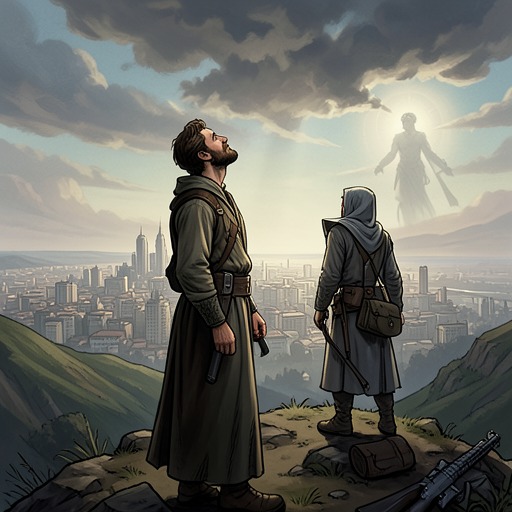
Destruction of Sodom and Gomorrah
Don't Leave God Alone: How to Get God's Attention, Remain in His Presence, and Even Change His Mind to Make a Difference in Your WorldDestruction of Sodom and Gomorrah is presented not only as an act of divine judgment but also as a missed opportunity for intercession. The book argues that the cities were destroyed after Abraham abandoned his appeal too soon, making the event a central warning about what happens when a person leaves God alone at the very moment persistent prayer might alter a city’s fate.
Judgment Announced and Intercession Opened
The account begins with God speaking to Abraham before the destruction. The book treats that disclosure as significant: God could have destroyed Sodom and Gomorrah without explaining His intention, yet He took the time to tell Abraham what He was about to do. The revelation is therefore interpreted as an opening for intervention rather than merely as advance notice of an unavoidable sentence. Abraham is portrayed as God’s friend and servant, someone invited into the crisis because his response could matter.
The episode is explicitly compared with Moses’s intercession for Israel. According to the book, Moses did not leave God alone when judgment threatened the nation, and his persistence resulted in an entire people being spared. Abraham faced a similar opportunity on behalf of Sodom and Gomorrah. The contrast between the two men supplies the event’s governing logic: judgment may be deserved, but a righteous person can still plead for mercy, and the willingness to continue pleading becomes part of the outcome.
Abraham’s Count and the Point of Departure
Abraham began by challenging the justice of destroying the righteous together with the wicked. In the retelling of Genesis 18, he stood in God’s path and asked whether the Judge of all the earth would treat good and bad alike. He first proposed that the cities be spared if fifty decent people could be found. God agreed. Abraham then continued lowering the number, asking whether mercy would remain possible for forty-five, forty, thirty, twenty, and finally ten righteous people.
Each reduction appeared to confirm that God was willing to hear the appeal. The negotiation is not described as a symbolic gesture with no practical consequence; the book says that God agreed to spare the cities for every number Abraham requested. This progressive counting gives the scene its rhythm and suspense. Abraham keeps testing the breadth of mercy, while the possibility of survival narrows from a substantial righteous minority to the smallest community he is prepared to name.
The decisive failure, in the book’s reading, came when Abraham stopped at ten. The text emphasizes that he originally pleaded on behalf of the people but ultimately gave up too early. He did not continue asking whether God would spare the cities for one righteous person, nor did he raise the specific possibility that his nephew Lot might be there. The catastrophe is consequently linked not simply to the cities’ wickedness but to the intercessor’s decision to stop counting.
The Cities Are Destroyed
Genesis 18:33 marks the end of the encounter: the Lord went His way, and Abraham returned to his own place. The book interprets this movement as the moment Abraham left God alone. Once the conversation ended, the opportunity for further pleading ended with it. The next stage was the destruction of Sodom and Gomorrah, when brimstone and fire fell from heaven and consumed the cities, the plain, the inhabitants, and the growth of the ground.
The event is therefore framed as a reversal of what might have happened. The book repeatedly insists that Abraham could have continued. Had he asked God to spare the city for one righteous person, the destruction might have been postponed or prevented at that time. The author even imagines Abraham continuing to press the case by mentioning Lot. That possibility is not presented as a recoverable historical fact but as the moral pressure of the narrative: Abraham’s persistence could have carried the appeal beyond ten, whereas his silence allowed judgment to proceed.
The consequence is described in stark collective terms. Two cities and the surrounding plain were destroyed, along with everyone living in the cities and everything growing from the ground. The scale of the loss makes Abraham’s interruption of prayer appear costly. In the book’s theology, one man’s unfinished intercession stood between a condemned population and the possibility of mercy.
A Pattern of Public Intercession
The destruction of Sodom and Gomorrah becomes a model for the book’s larger argument about cities and nations. The author says that God looks for people who will give Him a reason to intervene even when He is not obligated to do so. When judgment is deserved, the cry of one person may still call forth mercy. Abraham’s failure is thus placed beside Moses’s persistence: the difference was not that God was willing to hear one man but not the other, but that Moses continued while Abraham quit counting.
This interpretation extends the event beyond its biblical setting. The book presents prayer as capable of affecting cities, nations, churches, wars, storms, and other collective dangers. It identifies six destructive influences associated with silence concerning a city: violence, profanity, corrupt wisdom, defiled sanctuaries, iniquities, and terrorism or fear. Persistent prayer is described as a means of confronting these influences rather than merely reacting after disaster has arrived.
The same principle is applied to the United States. While praying for the nation, the author describes sensing the Lord’s presence and receiving the message that the nation was being given another chance, as Nineveh had been spared. This later application does not erase the destruction of Sodom and Gomorrah; it uses the event as a warning and a summons. The author concludes that believers should stand up for a nation and refuse to leave God alone until they see the desired change.
Collective Prayer and the Event’s Significance
The book connects Abraham’s halted appeal with later examples in which determined prayer is credited with changing danger’s outcome. After one failed attempt to prevent predicted storms in Florida, hundreds prayed fervently the following year, and the named storm did not strike as expected. The author also attributes the absence of major hurricanes hitting the United States in 2006 to people praying collectively, individually, and fervently. These examples function as modern echoes of the Sodom narrative: an initial response may be insufficient, but renewed determination is said to produce a different result.
The event is likewise contrasted with the early church’s response when Herod killed James and imprisoned Peter. Instead of relying on ordinary political or public tactics, the church prayed diligently, and the book presents its power as arising from refusing to let go of God. In this comparison, Sodom and Gomorrah represent the danger of ending the appeal, while the praying church represents the persistence Abraham should have shown.
Its final significance lies in the tension between deserved judgment and invited mercy. The book does not deny the evil attributed to Sodom and Gomorrah; it emphasizes that judgment was announced because the cities were considered guilty. Yet the narrative is read as showing that divine knowledge of guilt does not cancel the human responsibility to intercede. Abraham’s silence after ten becomes the event’s lasting image: the destruction demonstrates what judgment can do, while the unfinished count leaves readers contemplating how much might have changed had one person continued to ask.